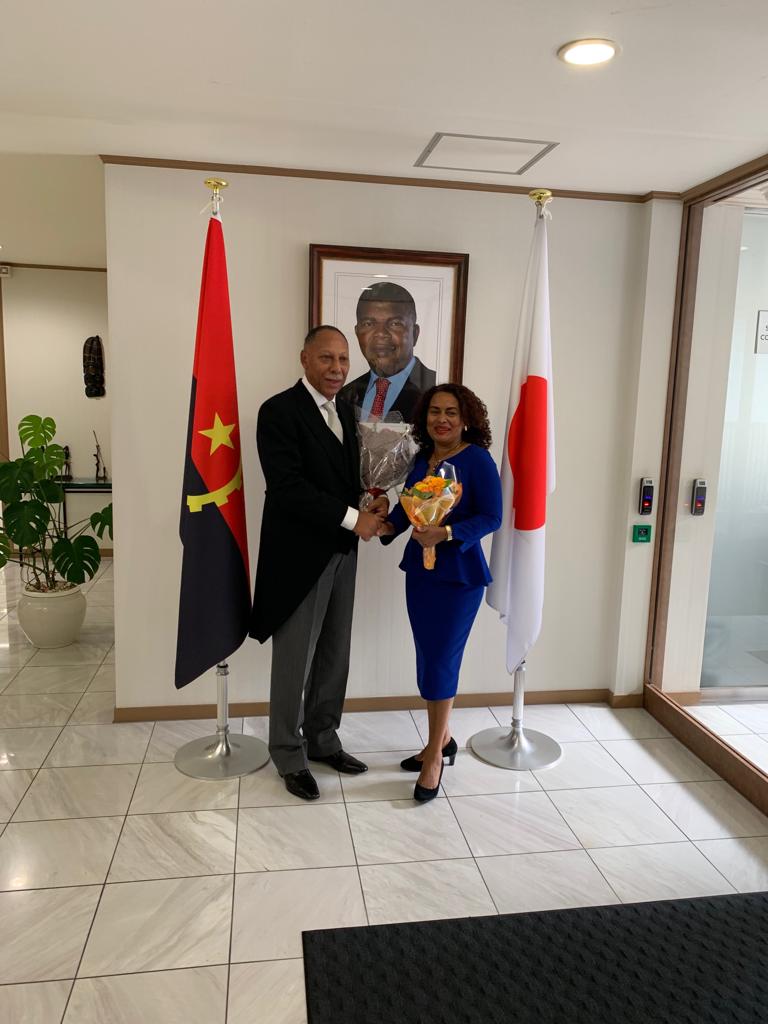
João Lourenço, President of the Republic of Angola / Photo: JAIMAGENS

On September 28 and 29, the President of the Republic, João Lourenço, nominated, by presidential decree, the heads of different government departments as follows:

Manuel José Nunes Júnior, as State Minister for Economic and Social Development;

Pedro Sebastião, as State Minister and Head of the Security Office of the President of the Republic

Frederico Manuel dos Santos e Silva Cardoso, as State Minister and Head of the Civil Office of the President of the Republic

Salviano de Jesus Sequeira, as Minister of National Defense

Ângelo de Barros da Veiga Tavares, as Minister of Interior

Manuel Domingos Augusto, as Minister of External Relations

Augusto Archer de Sousa Mangueira, as Minister of Finance

Adão Francisco Correia de Almeida, as Minister of Territory and State Reform

António Rodrigues Afonso Paulo, as Minister of Public Administration, Labor and Social Security

Francisco Manuel Queirós, as Minister of Justice

Marcos Alexandre Nhunga, as Minister of Agriculture and Forestry

Bernarda Gonçalves Martins Henriques da Silva, as Minister of Industry

João Baptista Borges, as Minister of Energy and Water

Diamantino Pedro Azevedo, as Minister of Mineral Resources and Petroleum

Augusto da Silva Tomás, as Minister of Transport

Manuel Tavares de Almeida, as Minister of Construction and Public Works

Victória Francisco Lopes Cristóvão de Barros Neto, as Minister of Fisheries and the Sea

José Carvalho da Rocha, as Minister of Telecommunications and Information Technologies

Ana Paula Chantre Luna de Carvalho, as Minister of Spatial Planning and Housing

Pedro Luís da Fonseca, as Minister of Economy and Planning

Maria do Rosário Bragança Sambo, as Minister of Higher Education, Science, Technology and Innovation

Maria Cândida Teixeira, as Minister of Education

Sílvia Paula Valentim Lutucuta, as Minister of Health

Maria Ângela Teixeira de Alva Sequeira Bragança, as Minister of Hotels and Tourism

Victória Francisco Correia Conceição, as Minister of Social Action, Family and Women’s Promotion

Carolina Cerqueira, as Minister of Culture

Ana Paula Sacramento Neto, as Minister of Youth and Sports

Aníbal João da Silva Melo, as Minister of Social Communication

João Ernesto dos Santos, as Minister of Former Fighters and Homeland Veterans

Jofre Van-Dúnem Júnior, as Minister of Commerce

Paula Cristina Francisco Coelho, as Minister of Environment

Ana Maria de Sousa e Silva, as Secretary of the Council of Ministers

Source: ANGOP

Members of the National Assembly take their seats at a constituent Meeting of the IV Legislature / Photo: Pedro Parente

The 220 members of the Parliament elected in the general elections held on August 23 of this year were sworn in at the National Assembly on September 28, for a five-year term. At the ceremony, the members of the Parliament took the oath of allegiance to the fatherland, received their individual badges, symbol of identification of the parliamentarians.

The Angolan National Assembly has 220 members, with 90 elected from provincial constituencies and 130 elected from a nationwide constituency. Following the general elections of 2017, the IV Legislature of the National Assembly will have 150 members from the MPLA, 51 from UNITA, 16 from the CASA-CE coalition, two from the PRS and one from the FNLA. Of the 220 newly elected members, 59 are women and 161 are men.

Source: ANGOP

João Lourenço, speaking for the first as President of the Republic / Photo: Pedro Parente

The President of the Republic, João Lourenço, was invested on Tuesday at the Square of the Republic, in Luanda, for a five years term. The winner of the general elections of 2017 on the MPLA (People’s Movement for the Liberation of Angola) ticket was invested by the President of the Constitutional Court, Rui Ferreira, before more than 30 thousand people.

The ceremony was attended by guests from several friendly States and also marked the end of the term of the outgoing President of the Republic, José Eduardo dos Santos.

João Lourenço assumes the destiny of a nation facing an adverse macroeconomic situation and his challenges will be the economic recovery and diversification as well as the maintenance of political stability. João Lourenço is the third President of the Republic of Angola following António Agostinho Neto (1975-1979) and José Eduardo dos Santos (1979-2017).

Source: ANGOP

Valter Filipe da Silva – Governor of the National Bank of Angola / Photo: Francisco Miudo

Angola is attending the 45th Ordinary Meeting of the Committee of Central Bank Governors (CCBG) of the Southern African Development Community (SADC), which will go from September 12th until the 16th. The Angolan delegation is headed by the governor of the National Bank of Angola (BNA), Valter Filipe da Silva and includes directors and other officials from the Bank.

The purpose of the meeting is to discuss the economic transformation of the SADC region countries, analyze macroeconomic policies, the development of trade and investment in the region, payments system, issues related to financial markets, banking supervision as well as information and communication technologies.

On the sidelines of the meeting, the governor of the National Bank of Angola will hold bilateral meetings with his counterparts, including the governor of the Reserve Bank of South Africa, to strengthen ties and address issues related to banking correspondence, as well as hold meetings with the governors of the central banks of Tanzania, Zambia and Namibia.

The CCBG was established in 1995 to address the need for a specialized structure to promote and strengthen cooperation among the SADC central banks. Angola, Botswana, Democratic Republic of Congo, Mauritius, Lesotho, Madagascar, Malawi, Mozambique, Namibia, Swaziland, Seychelles, Tanzania, Zambia and Zimbabwe are members of the CCBG.

Source: ANGOP

Elections/2017 – President of the CNE Announcing the Final Results / Photo: Joaquina Bento

A total of six political parties ran in the Angolan general elections held on August 23, namely, the People’s Movement for the Liberation of Angola (MPLA), the National Union for the Total Independence of Angola (UNITA), the National Front for the Liberation of Angola (FNLA), the Social Renewal Party (PRS), the National Patriotic Alliance (APN), as well as the Broad Convergence for the Salvation of Angola – Electoral Coalition (CASA-CE).

The official results, released on Wednesday, September 6, in Luanda by the National Electoral Commission (CNE), declared the MPLA winner with 4,164,157 votes (61.07%). With a qualified majority, the ruling MPLA party managed to get elected its candidates for President and Vice-President of the Republic, João Lourenço and Bornito de Sousa respectively, as well as 150 of the 220 parliamentary seats to the National Assembly.

The party lead by Isaías Samakuva, UNITA, came second in the general elections with 1,818,903 votes (26.67%) representing 51 parliamentary seats. The Casa-CE won 643,961 votes (9.44%) and 16 parliamentary seats.

The PRS garnered 92,222 votes (1.35%) and two parliamentary seats while the FNLA, received 63,658 votes (0.9%) and one parliamentary seat. The APN came in the last position, with 34,976 votes (0.51%), enough only to remain as a political party but not for a seat to the National Assembly.

Source: ANGOP

Angolan Head of State, José Eduardo dos Santos / Photo: Francisco Miudo

The President of the Republic, José Eduardo dos Santos, under the terms of the Constitution and the Organic Law on General Elections, issued on April 25 a presidential decree, which calls for General Elections to fill the office of the President of the Republic and Deputies to the National Assembly, be held on August 23, 2017.

According to a press release from the President’s Office released on Wednesday, the presidential decree, which follows the announcement by the National Electoral Commission that all conditions are created for the elections and after hearing the Council of the Republic, shall enter into force on 1 May 2017.

Source: ANGOP

Angola will host the AfroBasket 2017 from 19 to 30 August, replacing the Republic of Congo, FIBA Africa announced on its website.

The decision comes following the withdrawal of the Republic of Congo, who pointed to logistics issues as the reason for its inability to host Africa’s flagship basketball competition.

The decision on the selection of the new host was made after a meeting in Bamako, Mali between the Angolan Basketall Federation (FAB) and the FIBA Africa board. This is the third time that Angola hosts the event (1989, 1999 and 2007).

The 16 teams competing in the AfroBasket 2017 are: reigning champions Nigeria; Angola; Morocco, Tunisia, Mali, Senegal, Cote d’Ivoire, Cameroon, Democratic Republic of Congo, Egypt, Uganda, Mozambique and South Africa. Guinea and Rwanda, received each a wild card to attend the competition.

An additional wild card will be allocated in order to select the Republic of Congo’s replacement.

20170424c
Angola National Team / Photo:Clemento dos Santos

Source: ANGOP, FIBA Africa

Signing of the peace agreement in Luanda / Photo: JAIMAGENS

April 4 marks the 15th anniversary of the signing of the Memorandum of Understanding Complementary to the Lusaka Protocol between the Angolan Government and UNITA, which changed the course of events in the country’s history.

The agreement, signed in 2002 at the Palace of Congress in Luanda and witnessed by the Angolan President, José Eduardo dos Santos, and representatives of the national and international community, symbolized the end of the war, which left thousands of people displaced, mutilated and orphaned.

With the signing of the document, April 4 was decreed as a National Holiday and has became, among Angolans, a historical reference in the struggle of the people, as the date marks a decisive turning point in the political process and development of the Republic of Angola.

The date is also one of the greatest achievements of the Angolan people after the National Independence, on 11 November 1975.

The country now enjoys a just and lasting peace, a particularly important moment in its history, never experienced by the Angolan people, even in the distant past, since the birth of Angola as an independent and sovereign State.

It is a just peace because it was achieved not by the imposition of external forces but rather by the result of the efforts by Angolans who understood that there was a need to stop hostilities and to begin the process of completing the remaining tasks of the Lusaka Protocol, aimed at the establishment of peace and the ensuing reconciliation and reconstruction of the country.

For the first time a protocol, aimed at peace, was signed on the national territory, without any external mediation. This peace corresponds to the most legitimate interests of the Angolan people.

It is a lasting peace because it is being and must be consolidated in the daily lives of Angolans, through practical actions and attitudes, all of which must contribute to the irreversibility of this process.

It is the will of the Angolan people that all the factors of the past be removed, in order to build a united, solidary and mature homeland, guided by values such as national unity, democracy, freedom, social justice and respect for human rights.

With peace achieved, the Angolan people face new challenges. It is necessary to continue making efforts to consolidate peace by developing a set of actions to combat hunger and poverty.

Tolerance and respect for differences in opinion and party affiliation should also be promoted, as well as encourage the patriotic feeling of the population, especially among children and young people, and strengthen the institutions of the Democratic Rule of Law as an indispensable premise for a firm start towards the harmonious growth of the country.

As the President of the Republic, José Eduardo dos Santos said “those who truly love Peace must know how to forgive, to reconcile with their neighbors, thus contributing to a true and solid unity among Angolans, without prejudice to the differences that each can express.”

Today Angola has achieved its place in the context of the nations, at the political, economic and sports level.

Source: ANGOP

Officials talks between the delegations of Angola and South Korea / Photo: Alberto Julião

Cooperation in the military, naval and education sectors between the Republics of Angola and Korea gained momentum on 31 March with the signing in Luanda of a memorandum of understanding by delegations of the two countries.

The document signed for Angola by the State Secretary for Defense Policy, Gaspar Santos Rufino and for South Korea by the Vice Minister of Defense Minister, In Moo Hwang, also includes the exchange of official visits.

Speaking at the opening of the official talks, Gaspar Rufino highlighted South Korea’s technological capability and experience in the military and defense industry. He called for the deepening and the strengthening of cooperation between the two countries. He said that there is interest from South Korea in supporting Angola, if requested, in other branches of the Angolan Armed Forces, such as the Army and the Air Force.

South Korea’s Vice Defense Minister In Moo Hwang stressed the “good climate” of friendship and cooperation between the two countries, since 1995, when South Korea contributed peacekeeping troops to Angola. He anticipates that in the African context, Angola will establish itself as a great country. “It is in peace and has economic potential.” In Moo Hwang defended the development of friendship and cooperation ties with reciprocal advantages.

South Korea’s main investments in Angola are farm projects in Lucala, Cuanza Norte province, cotton farming in Sumbe, Cuanza Sul province and the Defense and Police Security Strengthening project.

Source: ANGOP

Tone Skogen, State Secretary for Foreign Affairs of Norway / Photo: António Escrivão

Angola is Norway’s main economic partner in Africa, because of the partnerships established in the oil and trade sector, said in Luanda on Wednesday, Tone Skogen, Norway’s State Secretary for Foreign Affairs.

Tone Skogen, who had a meeting with the Angolan Minister of Economy, Abrahão Gourgel, during her two-day working visit to Angola, said that the current partnership could be expanded to other economic areas, such as fisheries and renewable energy, particularly, to the hydropower sector. Angola is one of the importers of Norwegian cod.

Although optimistic about the possibility of further strengthening the economic partnership with Angola, Tone Skogen pointed out that there are some challenges that need to be resolved to expand the cooperation between the two countries.

Some of these challenges, according to Tone Skogen, are related to the access to foreign exchange, international wire transfers and current regulations that hinder the development of business in a timely manner. The issue of visas for businessmen is another aspect pointed out by Norway’s Secretary of State. Nevertheless, Tone Skogen assured that her country will continue to help Angola in the development of the oil sector.

The members of the Norwegian delegation will also hold separate meetings with the Ministers of Petroleum, José Botelho de Vasconcelos and the Minister of Fisheries Minister, Victória de Barros Neto.

Source: ANGOP

Please contact the Embassy to request permission to copy the content.

Scroll to Top