
Sorry, this content is only available in Portuguese.

The Republic of Angola was elected on 16 October by the United Nations General Assembly in New York, as member of the UN Human Rights Council, for the period 2018 – 2020. Angola was among the four candidates from Africa to the Council, alongside the Democratic Republic of Congo, Nigeria and Senegal.
In all, the General Assembly elected 15 new members, four from Africa, four from the Asia-Pacific, two from Eastern Europe, three for Latin America and two for Western Europe and other States.
Angola got 187 votes, out of the 193 possible. The other elected members are Democratic Republic of Congo, Nigeria and Senegal (Africa), Afghanistan, Nepal, Pakistan and Qatar (Asia Pacific), Slovakia and Ukraine (Eastern Europe), Chile, Mexico and Peru (Latin America and the Caribbean) and Australia and Spain (Western Europe and other states).
Angola submitted its candidacy in 2016 and was endorsed by the African Union (AU) during the organization’s Summit in July of this year. Angola has been a member of the United Nations Human Rights Council in the past, having served two consecutive terms from 2007 to 2013.
Based in Geneva, Switzerland, the 47 members Human Rights Council is a subsidiary body of the United Nations General Assembly, responsible for the promotion and protection of human rights since its inception in 2006.
Source: ANGOP

In order to deepen their understanding about the History, Culture, Society and other aspects related to Angola, a group of students from the Tokyo Metropolitan Roppongi High School visited the Embassy of the Republic of Angola on October 3, 2017.
The students attended a lecture by Mr. José Van-Dúnem, First Secretary.

On September 28 and 29, the President of the Republic, João Lourenço, nominated, by presidential decree, the heads of different government departments as follows:
Manuel José Nunes Júnior, as State Minister for Economic and Social Development;
Pedro Sebastião, as State Minister and Head of the Security Office of the President of the Republic
Frederico Manuel dos Santos e Silva Cardoso, as State Minister and Head of the Civil Office of the President of the Republic
Salviano de Jesus Sequeira, as Minister of National Defense
Ângelo de Barros da Veiga Tavares, as Minister of Interior
Manuel Domingos Augusto, as Minister of External Relations
Augusto Archer de Sousa Mangueira, as Minister of Finance
Adão Francisco Correia de Almeida, as Minister of Territory and State Reform
António Rodrigues Afonso Paulo, as Minister of Public Administration, Labor and Social Security
Francisco Manuel Queirós, as Minister of Justice
Marcos Alexandre Nhunga, as Minister of Agriculture and Forestry
Bernarda Gonçalves Martins Henriques da Silva, as Minister of Industry
João Baptista Borges, as Minister of Energy and Water
Diamantino Pedro Azevedo, as Minister of Mineral Resources and Petroleum
Augusto da Silva Tomás, as Minister of Transport
Manuel Tavares de Almeida, as Minister of Construction and Public Works
Victória Francisco Lopes Cristóvão de Barros Neto, as Minister of Fisheries and the Sea
José Carvalho da Rocha, as Minister of Telecommunications and Information Technologies
Ana Paula Chantre Luna de Carvalho, as Minister of Spatial Planning and Housing
Pedro Luís da Fonseca, as Minister of Economy and Planning
Maria do Rosário Bragança Sambo, as Minister of Higher Education, Science, Technology and Innovation
Maria Cândida Teixeira, as Minister of Education
Sílvia Paula Valentim Lutucuta, as Minister of Health
Maria Ângela Teixeira de Alva Sequeira Bragança, as Minister of Hotels and Tourism
Victória Francisco Correia Conceição, as Minister of Social Action, Family and Women’s Promotion
Carolina Cerqueira, as Minister of Culture
Ana Paula Sacramento Neto, as Minister of Youth and Sports
Aníbal João da Silva Melo, as Minister of Social Communication
João Ernesto dos Santos, as Minister of Former Fighters and Homeland Veterans
Jofre Van-Dúnem Júnior, as Minister of Commerce
Paula Cristina Francisco Coelho, as Minister of Environment
Ana Maria de Sousa e Silva, as Secretary of the Council of Ministers
Source: ANGOP

The 220 members of the Parliament elected in the general elections held on August 23 of this year were sworn in at the National Assembly on September 28, for a five-year term. At the ceremony, the members of the Parliament took the oath of allegiance to the fatherland, received their individual badges, symbol of identification of the parliamentarians.
The Angolan National Assembly has 220 members, with 90 elected from provincial constituencies and 130 elected from a nationwide constituency. Following the general elections of 2017, the IV Legislature of the National Assembly will have 150 members from the MPLA, 51 from UNITA, 16 from the CASA-CE coalition, two from the PRS and one from the FNLA. Of the 220 newly elected members, 59 are women and 161 are men.
Source: ANGOP

The President of the Republic, João Lourenço, was invested on Tuesday at the Square of the Republic, in Luanda, for a five years term. The winner of the general elections of 2017 on the MPLA (People’s Movement for the Liberation of Angola) ticket was invested by the President of the Constitutional Court, Rui Ferreira, before more than 30 thousand people.
The ceremony was attended by guests from several friendly States and also marked the end of the term of the outgoing President of the Republic, José Eduardo dos Santos.
João Lourenço assumes the destiny of a nation facing an adverse macroeconomic situation and his challenges will be the economic recovery and diversification as well as the maintenance of political stability. João Lourenço is the third President of the Republic of Angola following António Agostinho Neto (1975-1979) and José Eduardo dos Santos (1979-2017).
Source: ANGOP

Angola is attending the 45th Ordinary Meeting of the Committee of Central Bank Governors (CCBG) of the Southern African Development Community (SADC), which will go from September 12th until the 16th. The Angolan delegation is headed by the governor of the National Bank of Angola (BNA), Valter Filipe da Silva and includes directors and other officials from the Bank.
The purpose of the meeting is to discuss the economic transformation of the SADC region countries, analyze macroeconomic policies, the development of trade and investment in the region, payments system, issues related to financial markets, banking supervision as well as information and communication technologies.
On the sidelines of the meeting, the governor of the National Bank of Angola will hold bilateral meetings with his counterparts, including the governor of the Reserve Bank of South Africa, to strengthen ties and address issues related to banking correspondence, as well as hold meetings with the governors of the central banks of Tanzania, Zambia and Namibia.
The CCBG was established in 1995 to address the need for a specialized structure to promote and strengthen cooperation among the SADC central banks. Angola, Botswana, Democratic Republic of Congo, Mauritius, Lesotho, Madagascar, Malawi, Mozambique, Namibia, Swaziland, Seychelles, Tanzania, Zambia and Zimbabwe are members of the CCBG.
Source: ANGOP

A total of six political parties ran in the Angolan general elections held on August 23, namely, the People’s Movement for the Liberation of Angola (MPLA), the National Union for the Total Independence of Angola (UNITA), the National Front for the Liberation of Angola (FNLA), the Social Renewal Party (PRS), the National Patriotic Alliance (APN), as well as the Broad Convergence for the Salvation of Angola – Electoral Coalition (CASA-CE).
The official results, released on Wednesday, September 6, in Luanda by the National Electoral Commission (CNE), declared the MPLA winner with 4,164,157 votes (61.07%). With a qualified majority, the ruling MPLA party managed to get elected its candidates for President and Vice-President of the Republic, João Lourenço and Bornito de Sousa respectively, as well as 150 of the 220 parliamentary seats to the National Assembly.
The party lead by Isaías Samakuva, UNITA, came second in the general elections with 1,818,903 votes (26.67%) representing 51 parliamentary seats. The Casa-CE won 643,961 votes (9.44%) and 16 parliamentary seats.
The PRS garnered 92,222 votes (1.35%) and two parliamentary seats while the FNLA, received 63,658 votes (0.9%) and one parliamentary seat. The APN came in the last position, with 34,976 votes (0.51%), enough only to remain as a political party but not for a seat to the National Assembly.
Source: ANGOP

The President of the Republic, José Eduardo dos Santos, under the terms of the Constitution and the Organic Law on General Elections, issued on April 25 a presidential decree, which calls for General Elections to fill the office of the President of the Republic and Deputies to the National Assembly, be held on August 23, 2017.
According to a press release from the President’s Office released on Wednesday, the presidential decree, which follows the announcement by the National Electoral Commission that all conditions are created for the elections and after hearing the Council of the Republic, shall enter into force on 1 May 2017.
Source: ANGOP

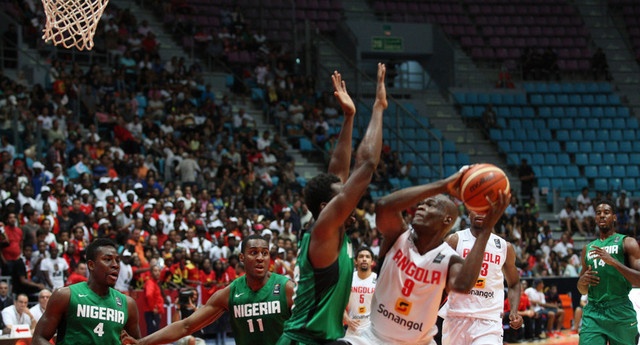
Angola will host the AfroBasket 2017 from 19 to 30 August, replacing the Republic of Congo, FIBA Africa announced on its website.
The decision comes following the withdrawal of the Republic of Congo, who pointed to logistics issues as the reason for its inability to host Africa’s flagship basketball competition.
The decision on the selection of the new host was made after a meeting in Bamako, Mali between the Angolan Basketall Federation (FAB) and the FIBA Africa board. This is the third time that Angola hosts the event (1989, 1999 and 2007).
The 16 teams competing in the AfroBasket 2017 are: reigning champions Nigeria; Angola; Morocco, Tunisia, Mali, Senegal, Cote d’Ivoire, Cameroon, Democratic Republic of Congo, Egypt, Uganda, Mozambique and South Africa. Guinea and Rwanda, received each a wild card to attend the competition.
An additional wild card will be allocated in order to select the Republic of Congo’s replacement.
Source: ANGOP, FIBA Africa